
How AI is transforming healthy habits: A new era of wellbeing

Whether we like it or not, artificial intelligence is here to stay. Early adopters and naysayers alike have a lot to say on the topic, but what is the science telling us?

How AI is changing healthy habits - at a glance
- AI helps personalise habit tracking and feedback
- Wearable devices use AI to spot health trends earlier
- Behaviour change is more effective with timely nudges
- AI supports prevention, not just treatment
- Human motivation still matters
When you hear the word ‘habit’, what comes to mind? Cleaning your teeth before bed, perhaps, or keeping on top of the washing? Or do you think about your exercise routine?
All these habits, which are engrained into our daily, weekly and lives in general, took time to form.
Around 40% of our daily lives are made up by these unconscious to-ings and fro-ings, but they don’t develop overnight.
Those Thursday evening swims or Saturday morning parkwalks didn’t become routine without a certain degree of effort.
According to Vitality research, it takes anywhere between seven and 15 weeks to form a strong and – more importantly – sustainable habit[1].
What role does AI play in building healthy habits?
But – and this is a big one – we can’t always do it alone. An encouraging nudge in the right direction can help us along the way – and there’s one tool in particular that’s been proven to help maintain our healthy habits... drum roll, AI.
Before you turn the page, hear us out. The likelihood is that we’re all using some form of AI or another without even realising.
Predictive text on our phones, navigation apps, online shopping – all of these touch-points will likely be using artificial intelligence to help improve your experience.
So, why not apply that to your healthy habits too?
How AI-powered apps and wearables support behaviour change
Studies show that AI-enhanced habit tracking apps are more effective at keeping us on the straight and narrow, compared with those that don’t use AI.
That wearable you’ve been donning since joining Vitality? It’s using AI, too.
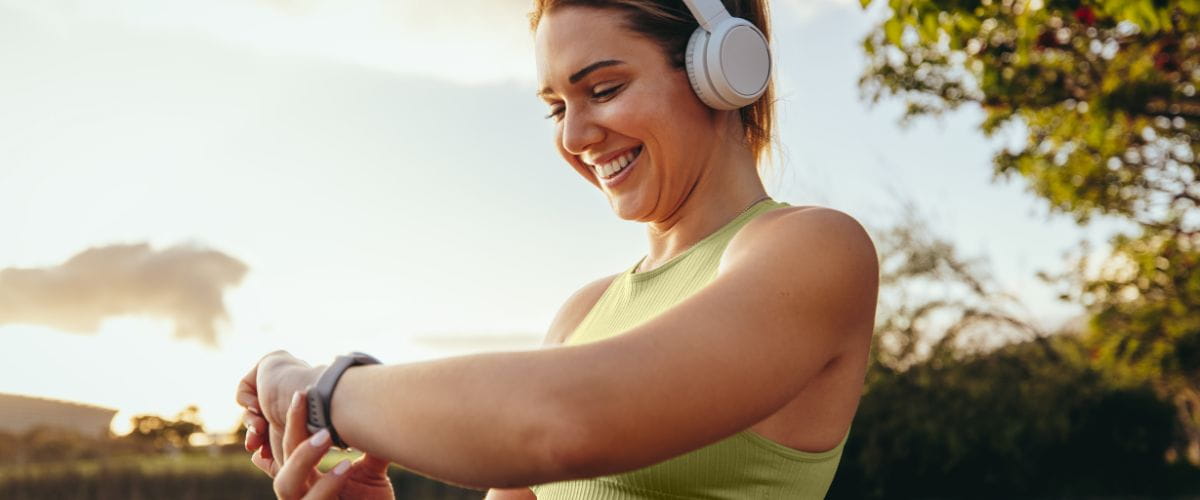
Depending on your device, Apple Watch can help to spot signs of sleep apnoea; while the Samsung Galaxy Watch uses AI to serve up personalised wellness tips based on your individual health data.
It’s true that there’s a mixed perception around AI in the UK. Four in 10 people expect it will have a positive impact on them as an individual and society as a whole, compared with three in 10 who anticipate it will negatively influence us.
“Since the inception of Headspace people have often asked us if technology and meditation is a bit of a paradox”
Dr Jenna Glover, Chief Clinical Officer, Headspace
Whichever fence you sit on, progress in AI is set to continue. The important thing is – if you are going to use it – do so to your advantage.
Whether that’s maintaining healthy eating habits or sticking to your mindfulness sessions – what’s there to lose?
5 ways you’re (probably) already using AI
- Predictive text is likely one of the most common ways that all of us use AI
- Food apps that scan labels and suggest healthy recipes
- Maps and navigation apps. Who even uses an A-Z anymore?
- Smart speakers. If you don’t have one at home, you'll know someone who has
- Social media’s AI algorithms determine the posts that you will see on your channels
Can AI really help us stick to healthy routines?
New research states that there are 454 million smartwatch users worldwide[2].
So, a hefty chunk of people globally are living (literally) with health intel just a fingertip away – meaning AI is already being embedded into our everyday lives.
But are smart watches – and their AI capabilities – as impactful in helping us stick to our healthy habits as they propose to be? The research suggests that AI-based nudges do in fact work.
“Technology in itself isn’t inherently bad, but it’s our relationship with it that we need to manage so that we are using it in healthy ways and not letting it overtake our lives”
Dr Jenna Glover, Chief Clinical Officer, Headspace
By giving gentle reminders to users to make healthy choices, whether that’s to take a break, drink more water or that you have 30 minutes left to achieve your weekly exercise goal, we are more likely to achieve them, data shows.
One study found that recipients of personalised nudges experienced a 6% increase in daily steps, along with around 8% increase in weekly activity minutes, compared with those who were not nudged.
The Vitality Programme works in a similar way. We want to encourage our members to set the right goals for them to transform their health.
This could be anything from stopping smoking to managing our weight or upping physical activity and doing more mindful minutes.
Using this sort of technology in another form is Vitality partner, Headspace. In 2024, it introduced its AI-powered tool, Ebb.

Designed to navigate ‘life’s ups and downs’, the tool listens and responds to users and gives personalised recommendations on how to deal with their emotions in real-time.
Headspace stresses that Ebb is not to be mistaken for a substitute for human care. That being said, it can be seen as a pocket-sized emotional supporter that helps people to understand the way they are feeling or behaving.
There are challengers of this type of technology, however. Something Jenna Glover, Headspace’s Chief Clinical Officer, is well aware of.
“Since the inception of Headspace, people have often asked us if technology and meditation is a bit of paradox,” she explains.
“The reality is [that] providing mental wellbeing resources through technology provides a point of access for people who may have not otherwise had it.”
The benefits – and limits – of AI in wellbeing?
The benefits of AI and its limitless potential aside, some do still understandably question the safeguards in place around privacy and data.
To overcome this challenge, Umang Patel, Microsoft’s Chief Clinical Information Officer, believes there are learnings to take from social media – a horse that has already bolted – regarding the measures needed to prevent AI from taking on a life of its own.
“We thought: ‘Maybe it [social media] will take off, maybe it won’t and now everyone's got it, and [we can see that] there’s some harmful stuff that has come from there,” he explains.
“I think big companies are in a good place to look at [using AI tools] across a manageable population, versus it just being something that's out there all the time, with people potentially using it in an unsafe way.”
Somethings Headspace’s Glover backs up. “Technology in itself isn’t inherently bad, but it’s our relationship with it that we need to manage so that we are using it in healthy ways and not letting it overtake our lives,” she explains.
“In fact, mindfulness can improve our relationship with technology by making us more aware of the effect it may be having on us in the moment.”
So, what’s next? “This is only the beginning,” concludes Dr Katie Tryon, Vitality's Medical Director.
Is AI the future of preventative health?
“At Vitality, we are always looking for new ways to harness AI to help our members unlock healthier habits and ultimately live longer, healthier lives. This, we believe, is the future of healthcare providing it is done in a way that is safe, ethical and managed securely,” says Tryon.
[1] Vitality Habit Index, 2024
[2] Demandsage 2025
Related: What is private health insurance and is it worth it?
.svg?rev=beee8ed27a30406c90f43e416683bd57&h=200&w=200&la=en&hash=BD6474559D7116C5D96470A6B9B1ECDD)
- Private healthcare from as little as £1.45 per day1
- Rated 5 Star by Defaqto
- Get healthy to earn rewards like Apple Watch
1 Price is based on the following criteria: a 35-year-old based in Peterborough, plan start date April 2025, Full Medical Underwriting, Consultant Select hospital option, £250 excess and £500 out-patient benefit and includes Insurance Premium Tax (IPT)
Recent articles

The fundamentals of sleep: Why quality rest is essential for your health
Sleep isn’t just ‘switching off’, it’s active recovery for your brain and body. New research drawing on more than 47 million nights of tracked sleep suggests that building consistent sleep habits could support long-term health in a big way. Here’s what quality sleep really means, why regularity matters as much as hours, and a few simple habits to help you wind down tonight


Why do we sleep? The science behind our need for rest
The truth behind why we sleep still baffles some scientists. However, with emerging research still shedding light on this after-dark phenomenon, new findings from Vitality have gone even further to show the physical and emotional benefits of a decent night’s kip


Power napping: Is it worth it (and how do you do it properly)?
Power nap or push through? A short snooze might be the reset your brain’s asking for – but only if you keep it brief. Here’s how to nap to boost energy (not grogginess), plus what Vitality’s latest sleep research says about why consistency matters

- Private healthcare from as little as £1.45 per day1
- Rated 5 Star by Defaqto
- Get healthy to earn rewards like Apple Watch
1 Price is based on the following criteria: a 35-year-old based in Peterborough, plan start date April 2025, Full Medical Underwriting, Consultant Select hospital option, £250 excess and £500 out-patient benefit and includes Insurance Premium Tax (IPT)